
Final Fantasy VII

- Intro
- Story
- Gameplay
- Presentation
- Spoilers
- Conclusion
The video game industry owes its current standard for cinematic storytelling to two very pivotal titles: Metal Gear Solid and Final Fantasy VII.
These two juggernauts proved to the world that gaming as an entertainment medium can be more emotionally complex than the likes of Pac-Man, Contra, or A Link to the Past, and can in fact qualify as actual works of art.
Final Fantasy VII also firmly planted Square as a respected developer in the west by way of strong marketing, fortunate timing, and development prowess. Today, it's impossible to list and analyze every way that this single title has influenced gaming and the very lives of those it has touched, directly and indirectly, because it's honestly unquantifiable.
Whether or not it lived up to the hype of the time or the legacy of today is less important than what it achieved as an experience, but it's hard to deny that it delivered on both fronts.
It's remarkable how striking the story of Final Fantasy VII is presented in spite of its age, tremendous localization issues, and disparate narrative focuses throughout the game's development. A good number of scenes are directed with style, using creative transitions and well-timed musical punctuation. There are times where it is difficult to determine where to go next and for what purpose in the plot, but this never reaches Ocarina of Time levels of obscurity or ambiguity.
The game's assorted cast of characters is easy to grow attached to and feel truly fleshed out as people, cogs in the greater machine that is the setting. You can find hints that their individual paths haven't always lined up as they lived their own lives, leaving trails of history that can be discovered through the campaign and exploration. Tifa owns a bar in Midgar's Sector 7 slums, serving as the base of operations for AVALANCHE. This ragtag eco-terrorist group may have been part of a plot to assassinate the president of the Shinra Electric Company. In a town far away from Midgar, a short-tempered flyboy named Cid was meant to be the first man in space before Shinra shut down the program in order to forward those funds to their own military campaign against the country of Wutai, the homeland of young ninja Yuffie. Said military has varying branches and divisions, the highest of which held Sephiroth and Cloud among the most prestigious class before both departed on divergent paths. Every locale is teeming with characters that drip with flavor lore like this and it all adds up to a very real and tangible setting full of history and interconnectivity.
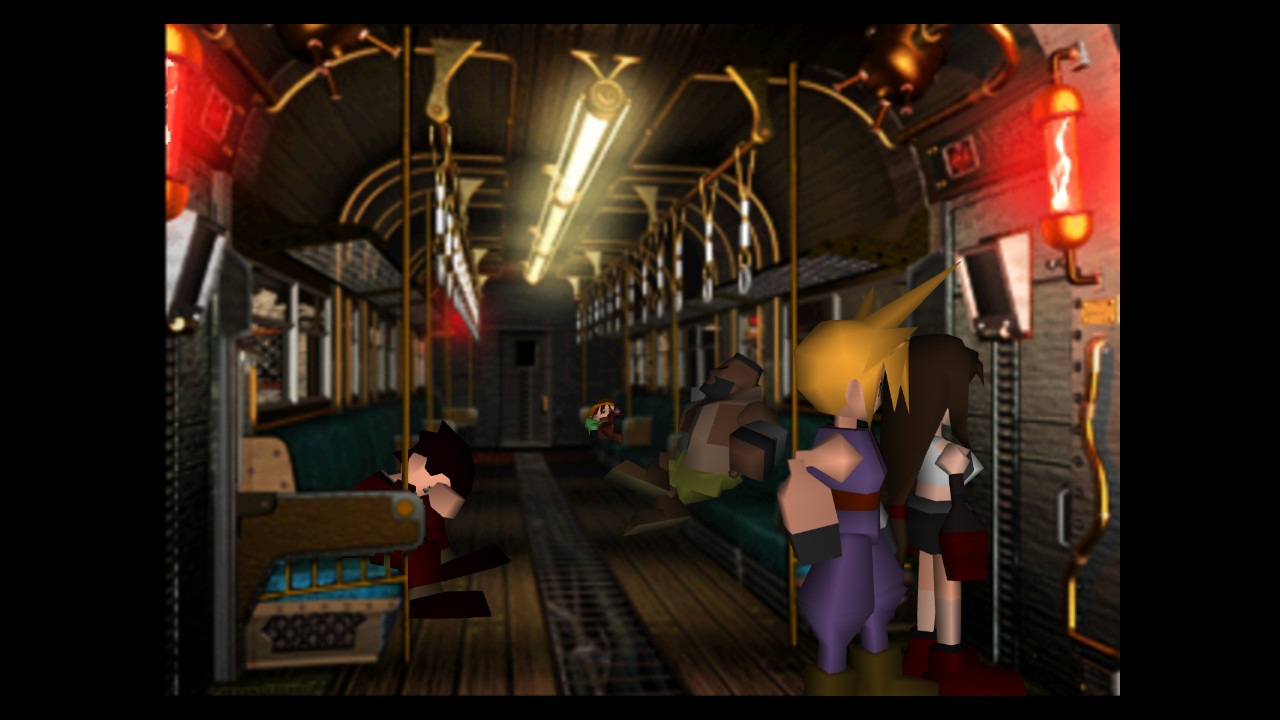
Carrying this roster through the narrative is the wake of death and destruction that follows Sephiroth, former SOLDIER 1st Class like our main man Cloud. Sephiroth's deeds spell doom for the planet and our party is determined to stop him in his tracks. This quest takes them across the globe through a wide array of circumstances and scenarios that inject personality into the story. One minute Aerith is helping Cloud get dolled up to pose as a woman and bail Tifa out of a bordello, the next minute Cloud is fending off Shinra troops atop a motorcycle. Each moment is ripe with character, spiced up between bouts of humor and drama.
I feel that the goofiness of Final Fantasy VII has been overshadowed and forgotten by its property holders, choosing instead to cast a darker and more serious light on it for edge appeal. In reality, Cloud is kind of a dork, and Barret is an animated Mr. T type dude with a big heart. Rather than a saintly do-gooder angel, Aerith is probably the most willing to get her hands dirty when the going gets rough-- disobeying her mother, scamming ne'er-do-wells by charging them extra for her flowers, and getting herself into heaps of trouble without thought to greater consequences.
A great carryover from Final Fantasy VI is that your chosen party members affect each scene. The plot will always play out mostly the same, but obtaining optional characters opens up some additional content and each character reacts to story events differently with unique dialogue and interactions. This adds a considerable amount of replay value for those that want to see how perhaps Vincent might react to Cid's domestic abuse compared to the way Tifa does, or how Barret reacts to Bugenhagen's lifestream lecture compared to Red XIII. Though only semi-malleable, these varied interactions are a fun reward shaped by the player's decision to bring the characters they do such that it may be the ultimate deciding factor for them.
Final Fantasy VII is tightly knit with twists and reveals, taking risks in its storytelling and subject matter in a way that I can't help but respect. Execution lacks polish and nuance a lot of the time, but what's there does wonders at instilling mystery, doubt, intentional confusion, and a burning desire to know more. I have no doubt that this deeper mystification is a big part of the game's staying power because it inherently lends to a sense that the world's lore runs deeper, begging to be explored and ruminated upon. Plot holes exist and plenty of threads are left untied, but these blemishes pale in comparison to the title's epic spectacle and relatable themes of identity, mortality, love, loyalty, and just about every complex emotion a person can feel.
One of the most potent tools at a game's disposal is gameplay and story integration, where a mechanic or system directly serves as a plot device and vice versa. One of my favorite examples of this is when Cloud recalls a memory where he fights alongside Sephiroth as allies on a mission for SOLDIER. In this battle, it's extremely likely that our level 1 Cloud will be flattened by the creature which is far more powerful than anything you've fought in the game thus far. Sephiroth, a whopping level 50, two-shots the creature, slashing dealing damage ranging in the multiple thousands. In this scene you aren't only told of Sephiroth's immense power, you are shown it and even reliant upon it. There is no getting around how formidable a foe he will be in your eventual clash and this one moment in the story exemplifies this fact in a clever, exciting, unforgettable way.
An understated aspect of Final Fantasy VII is the impressive scope and diversity of its world. Midgar is shown to be a massive two-tiered dieselpunk city with public transit systems, communities, seedy underbellies, and lavish high societies. Outside of Midgar is a vast landscape of lush forests, sparkling seas, twisting mountains, and so-on. Trekking to these locations is done through the world map, a 3D variation of those found in Final Fantasies of old. Unique to this game's iteration is how it's used to tell parts of the story, such as showing certain creatures on the map to demonstrate their immense size and almost smother the sense of safety usually found on the world map. The length of time it takes to travel between locations relies on implication through abstraction, where visitable areas like towns are barely larger than Cloud himself yet the expanses between are massive. Old games used tricks like this to play up the scale of their settings in order to work around hardware limitations that stood in the way of large and seamless open worlds. Our imaginations paint a grander picture by filling in certain gaps in a way that technology couldn't illustrate which is why we remember Ocarina of Time's Hyrule or Final Fantasy VII's Gaia to be so grand and epic. We've crossed an interesting threshold in gaming today where worlds are larger now than we ever thought possible, so now the issue becomes how to fill them with meaningful content or else struggle with seeming smaller than they have any reason to. Eos in Final Fantasy XV is an irrefutably larger map than Gaia, yet the combination Final Fantasy VII's implied scope and the rich landscape of content give each of its admittedly fewer areas more purpose and interest to the point that it feels somehow larger than the world in Final Fantasy XV.
Random encounters lead to Active Time Battles which were nothing new by this point in the franchise, but this doesn't lessen the impact and urgency permeating the title by its inclusion. Its introduction in the fast-paced Bombing Mission sequence that the game opens with strongly instills the time-sensitive tone despite no overarching time shenanigans taking place like in Chrono Trigger, instead merely serving to ground the game in reality and hint at a larger picture in a subtle way. I think a lot of past entries had a strange sense of standing still when the player wasn't actively participating in their story, but Final Fantasy VII conveys life and perpetuity very simply in its implementation of systems like this and in its world design.
The combat itself is rock-solid, armed with a variety of enemy types, buffs, debuffs, weapons, armors, accessories, etc. Like in Final Fantasy VI, the party consists of characters that play like diluted versions of the classes they represent. You don't have the standard white mages or dragoons, instead, you have Aerith and Cid-- fulfilling the roles of said classes, sure, but less strictly. The easiest way to demonstrate the jack-of-all-trades design behind the party is by analyzing the first set of characters as well as the gear and abilities they have at that time. All of them can use the same spells, skills, attacks, items, armor, and accessories. Even the characters' natural traits don't vary to the point that any single member serves as the defacto black mage or tank. Instead, diversity is defined by each character's weapons and Limit Breaks. Only Cloud can wield the hulking Buster Sword, and Yuffie wouldn't know what to do with Barret's gun-arms, lending to far more sentimentality for each piece of weaponry than in the series past. The true classification of the characters is found within their Limit Breaks, however, allowing them to perform especially powerful moves after taking enough damage to fill the appropriate gauge. A variety of Limit Breaks exist for each member, providing unique benefits and tactical advantages in battle. Tifa barrages her foe with a combo of punches and later tacks on somersaults and uppercuts; one of Cloud's later Limit Breaks has him reel back with his sword before cleaving the air to manifest an energy beam that splits into two more beams upon impact with the targeted foe. Not only are these moves useful, but they're also flashy and sprinkle some drama into each fight.
All spells and abilities are made possible through Materia, crystallized spheres of energy that can be slotted into a character's weapons and armor. It's a robust system that empowers the player to develop intricate strategies, enlivening battles with added depth and complexity. Equipped Materia offers their powers to the wielder and level up through AP earned at the end of battles. Said abilities reside solely within each piece of Materia rather than how the Magicite system of Final Fantasy VI taught the ability to the wielder forever. Because Materia can be easily swapped around, you don't feel neutered quite as harshly when the story strong-arms characters into or out of your active party. Where Materia gets really cool, though, is in combinations. Each piece of equipment contains a varying number of Materia slots, some of which are linked which allow the fitted Materia to work together if compatible. Combos range from basic ones like Elemental + Fire on your weapon to deal fire damage with every strike to way cooler ones like Added Effect + Odin for a chance to instant-kill with each hit instead. Very nearly endless are the possibilities afforded here and discovering new and creative combinations is some of the most fun you'll have with any progression system in all of RPGs. Even today I'll see a brand new combination on YouTube I had never seen or considered and just be blown away by the madness they can conjure.
Structurally, the game is again highly reminiscent of its predecessor. A large percentage of the opening hours are spent navigating linear maps between narrative setpieces, only opening up once the party leaves Midgar. This specific moment brilliantly astounds and surprises by firmly telling the player, "I've taught you all I know" and letting go of their hand. The world looms before you in all its scale and glory. Open fields with mountains, towns, and beaches beg to be traversed in pursuit of monster farming, secret hunting, and story progression. Exploring Gaia's caves, villages, and industrial complexes is exciting and the design of each location makes the world seem so much larger and more intricate than what should be possible for the time.
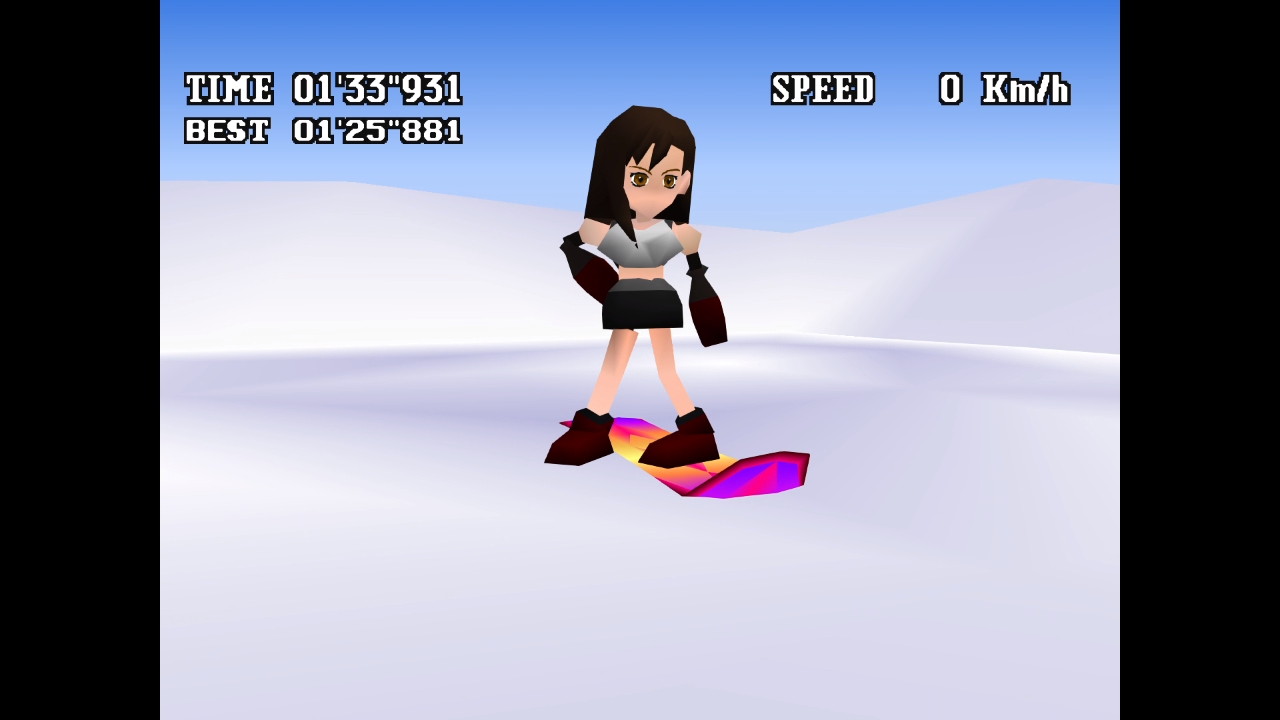
Final Fantasy loves its minigames and the seventh installment is no exception. It seems a new one is introduced at least every hour with varying levels of success. There are some solid picks here, such that one was even turned into a full-fledged mobile game, but I find they can be unwieldy to control until you get in some practice. The submarine minigame, for example, can be a dreadful experience if you don't exploit the fact that your target spawns right in front of you at the start. Not doing so will see you struggling with the controls for an exhausting amount of time as you confusedly maneuver through the darkness trying to find the target again. The most inspired aspect of the minigames is that re-experiencing them is as simple as visiting a single location called the Gold Saucer, an amusement park containing the minigames of the main campaign as well as ones unique to the park. Playing the submarine minigame in the Gold Saucer removes the narrative stakes and allows you to run through its handful of levels repeatedly, growing more comfortable in its control scheme and more accustomed to its nuances, and therefore less frustrating.
I was surprised at the game's plethora of puzzles, from dropping barrels onto Reno's thugs in Aerith's church to the upper floors of Shinra headquarters. Their solutions are fairly logical to decipher and I applaud their many failure states, often just lesser rewards for subpar completion of the puzzles or something pretty cool if you figure them out perfectly. These are some of the most satisfying offerings in terms of replay value because they often result in nuggets of additional story, powerful gear, or rare Materia.
23 years ago, Final Fantasy VII was the series' first foray into 3D game design. The technology was impressive for its time with film-quality CG cinematics, polygonal character models, and the ability to move around a 3D space. These radical concepts coupled with pre-rendered backgrounds give the game a unique style that has evolved from impressive to charming over time.
Tetsuya Nomura would get his big break as character designer for the game, ushering in a new illustrative age for Square full of spiky hair, big eyes, and bigger breasts. Dawning an anime style, the roster designed by this talented artist pop and stand out against the more realistic aesthetic of the environmental art. Few video game characters are as iconic as Cloud with his spiky blonde hair, purple getup, and enormous Buster Sword. Tifa is a darling of the industry that's nearly as ubiquitous for her incredibly alluring design as Lara Croft. Sephiroth oozes a cool and badassery that few villains could even dream. Everyone looks great or at least fitting, instilling identity and charm at every turn.
Opening - Bombing Mission, Mako Reactor, Tifa's Theme, Aerith's Theme, Shinra, Inc., J-E-N-O-V-A, Listen to the Cries of the Planet, One-Winged Angel. Nobuo Uematsu's score for Final Fantasy VII would serve as his magnum opus, a pivotal achievement in his career that frankly has yet to be bested by himself or any other composer in Square. The soul and passion of each piece is palpable and so much of the story's weight is rooted within them. Look no further than Cloud's retelling of Sephiroth's spiral into madness with the slow progression of Those Chosen by the Planet; beginning with only the slow drums and bell, increasing in pace as you descend into the Shinra Mansion basement then finally erupting into the full song when you confront Sephiroth. It's an incredibly well-directed moment that perfectly establishes the drama and tension needed to frame Sephiroth as the monster we had only seen glimpses of. Much in the way that you couldn't have Star Wars without John Williams, Final Fantasy VII wouldn't be the showstopper it is without Nobuo Uematsu.
Being a heavily menu-driven game, it was important to get the UI right and fortunately Square did just that. The interface is incredibly clean, showing precisely what needs to be seen and offers a variety of submenus for customization, information, and personalization. Though poorly telegraphed, there are some very useful tools baked in to make inventory management less tedious. Failing to recognize or discover these utilities will result in a more annoying time with such tasks, but their inclusion deserves merit. There is nearly no HUD to the game as exploration lacks a minimap, compass, or button prompts. It's possible to toggle on-screen indicators for the exits of your current screen and a hand pointing at Cloud's position, a useful convenience feature when the terrain has no clear exits or if Cloud is obstructed by terrain, even if I don't personally make use of it. Minigames tend to employ some unique HUD elements, though they lack important information and fail to clearly illustrate the intent or goal, making them more of a hindrance than an asset.
In what seems to be a strange attempt at deflating and undermining the impact and significance of this title, many like to point out that Final Fantasy VII was not the first game to kill off a party member or important character, even within its own series. This seems to be a misguided and toxic outlook because the death of Aerith was an important milestone in video game storytelling. What has become lost on these individuals is that the significance doesn't lie in the fact she dies, but rather in the details surrounding her death. It's the scar she leaves on those that had bonded with her. As Sephiroth retracts his sword from Aerith's body, he begins monologuing at Cloud the way you'd expect a villain to. Rather than sitting there and letting him do this, though, Cloud tells Sephiroth to shove it-- that none of what he has to say matters because Aerith is gone, and will never again smile, laugh, cry, or get angry. Yuffie bursts into tears and cries into Cloud's chest, Barret weeps and places his hand on Cloud's shoulder to comfort him, and more than likely the player holding the controller is shedding their own tears as well. The emotional impact of this moment is raw, but I think the most critical way it establishes and maintains its power is how the rest of the game plays out. Aerith is gone and all of her abilities and tactical uses are gone with her. There's a hole where she used to be that is never filled by anyone else either mechanically or narratively, effectively demonstrating the loss that comes with the death of someone that was part of your life. All of the time, energy, and progression poured into her as a party member sank with her to the bottom of the lake in the Forgotten City, and how deeply this cuts into each character shapes the rest of the journey in such a way that constantly feeling her absence is unavoidable.
I find it interesting that the Cetra are defined differently by Aerith and Sephiroth, adding to the intentional confusability of the story. Sephiroth explains that the Cetra travel between planets in search of the promised land. Aerith, on the other hand, describes the Cetra as being born from the planet and then returning to the planet when they die, their energy recycled to breed new life. Interestingly, Sephiroth's description seems to match that of Jenova while Aerith's is more in-line with normal people. Sephiroth's misdefinition of the Cetra seems to stem from Professor Gast's misunderstanding of Jenova, the Calamity from the Sky, who mistakenly classified it as a Cetra merely because of its carbon-dated age. What all of this essentially means is that Sephiroth owes his very existence to a misunderstanding and that his drive is completely misplaced under the falsehood of being the rightful ruler of the planet and its people.
Cait Sith is a troublesome character. His design is atrocious, his combat applications are weak, and his plot relevance is eyebrow-raising at best. He clumsily forces himself into the party, betrays them and then in the same breath demands friendship and claims to believe in the party's cause only to immediately threaten Marlene when told to beat it. For me, the nail in the coffin with regard to Cait Sith as a character was his death scene at the Temple of the Ancients. It's built up as a grand sacrifice before being immediately swept under the rug by bringing him back in the next scene, robbing the scene of all emotional weight that might have existed for those that bothered to care in the first place. This wouldn't come off nearly as tonally bipolar had the plan been presented as, "Hey Cloud, just use my artificial body to solve the puzzle. I can send a replacement to you afterward so we'll have lost nothing and keep the Black Materia out of Sephiroth's hands!"
My personal favorite aspect of the story in Final Fantasy VII is Cloud's state of mind. Throughout the adventure, even as early as the opening mission, it's shown that something isn't quite right with him. Various scenes are interrupted by screeching sounds, Cloud grasping his head in pain, and sometimes even passing out. He occasionally interacts with a voice in his head whose origin is never definitively established, and overall you get this sense that he isn't entirely himself.. that maybe he's more than one person. A combination of mako poisoning, physical and emotional trauma and an inherent desire to be more than himself result in a Cloud that mirrors his old friend, Zack Fair, who was murdered by Shinra in front of Cloud's very eyes. Donning the legacy of Zack and his Buster Sword with it, Cloud is found nearly comatose in Sector 7 by Tifa shortly thereafter. Though she recognized Cloud physically, his personality seemed disconnected from the Cloud she used to know, and a large portion of the story shows Tifa testing and observing Cloud to see if she can understand just what exactly is going on with him. How can he know the things he does despite his being absent from her own recollection of the events that Cloud tells the party and player? The full extent of this realization is actually left surprisingly optional, making for very rewarding side content and generally manifesting in some of the game's most emotionally impactful moments that still blow my mind during repeat playthroughs.
Final Fantasy VI had an insane 21-minute ending that intricately and satisfyingly wrapped up the threads of its characters and plot. Final Fantasy VII ends with a cinematic flourish, though in not nearly the same length of time and leaves a lot open to interpretation. Frustrating as it may be to lack firm closure, the open-ended nature of this ending sparks thought and discussion in a way that further lends to the game's longevity. My personal closure was discovered upon the realization that reaching this point was only possible by Cloud overcoming his trauma, finally relying on his friends while proving to himself that he's enough, and emotionally dealing with Aerith's death one step at a time.
There's no getting around this, so enough beating around the bush: Final Fantasy VII is a masterpiece.
You can nitpick its dialogue, the random encounters, and some of the wonky minigame controls, but doing so feels distasteful; disrespectful, even. Its numerous accomplishments elevated the entire industry to monumental heights and even those that played it at release knew that this was a turning point-- that Final Fantasy VII had changed everything.
Epics were no longer restricted to novels or film only to be passively observed and reflected upon, it had now been demonstrated that they could be actively participated in and interacted with. Games weren't mindless distractions of bright colors and adrenaline but were capable of delivering deep and nuanced stories. This title's unrelenting atmosphere, charming characters, impressive visuals, bewildering musical score, deep and rewarding combat, and massively complex story make it an absolute treasure even to this day. It's a timeless classic with so much to say and teach whose lessons are still being taught and followed in the gaming landscape and beyond.
There's a reason you've heard of Final Fantasy VII; why it's become a household name; why it was remade 23 years later and why so many JRPGs have copied and referenced it since release: it's a truly astounding, unwavering achievement in video games and considered by many to be the greatest of all time.
Pros
- Powerful & emotional story
- Strong & memorable characters
- Masterful soundtrack
- Addictive combat & progression
Cons
- Janky minigames
- Sloppy translation




LOVE
Similar Games
- Final Fantasy VIII
- The Legend of Dragoon
- Xenosaga Episode I