
FINAL FANTASY VI

Final Fantasy VI is simply amazing. While not without its flaws, it is truly a timeless work of art that stands up among the best games ever made with its dark and beautiful story, deep and diverse characters, charming visuals, and masterful music.
- A loving and well-crafted narrative that will make you laugh as often as cry. Final Fantasy VI makes great strides in carefully-yet-loosely guiding the player through the plot and for the most part avoids the trappings of prior games that would often leave the player left wondering what do next and where to go. There are twists and turns that keep you on the edge of your seat and moments of true brilliance that will leave your jaw dropped.
- The huge cast of characters are unforgettable and unquestionably lovable. You can nitpick certain character decisions and motivations, but all of them stand the test of time.
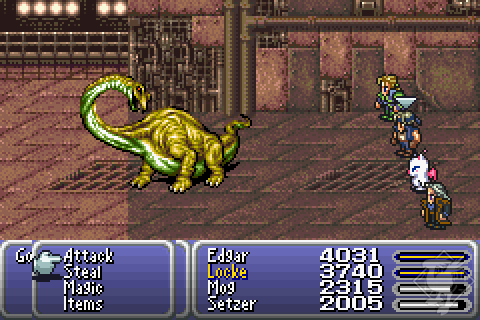
- The exploration and combat loops are some of the most satisfying I’ve experienced in a Final Fantasy. The Magicite system is an extremely deep yet approachable variation to typical leveling models that offers a great level of customization.
- With Magicite, you equip Espers to your characters and as those characters win combats, they’ll earn Magic Points that continue to add up until you learn all spells/abilities the equipped Esper offers.
- Between the Magicite, equipment, relics, and the characters’ native abilities, there is such a considerable level of customization that the game is begging to be replayed over and over.
- The sprite-work is of the highest caliber and does so much to realize the world and its characters. You get the right amount of detail that leaves just enough to the imagination. Its style is charming and oozes personality, perfectly complimenting both values in the story. It’s impossible to not fall in love with this game from its visuals alone.
- Some of the best music in the series; there are a lot of wonderful and iconic pieces that’ll never fail to bring a smile to your face. Terra’s Theme is elegant, mystical, and beautiful. Dancing Mad is dark, chaotic, and powerful. You really cannot go wrong with any track of this OST.
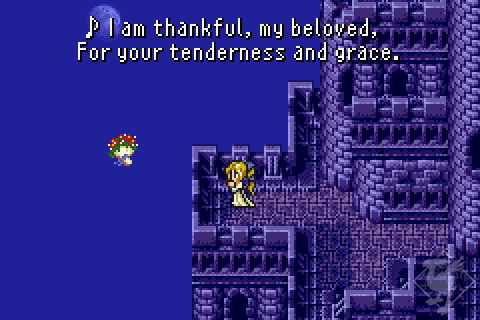
- This is my second playthrough of Final Fantasy VI. The first time I played it was a bit over 10 years ago, so I was shocked to find myself humming along with the opera scene as it played and even remembering the words. That, if nothing else, is a sign of truly great
music.
- The UI, while not terrible, leaves a lot to be desired. Managing the characters’ equipment, relics, and Espers can be a pain in the ass due to general lack of information for the player.
- I was so anxious to play the game again with different characters customizations that in the middle of my playthrough, I started two more!
Wow, what a ride. In this analysis, I’m going to discuss specific plot points and characters then try to explain their significance on their own, and conclude with how they all add up to the near-unmatched experience that is:
FINAL FANTASY VI
When you boot the game, the camera slowly crawls down a sky filled with storming clouds, thunder punctuating flashes of lightning. The low, droning score builds as we pan lower and lower, finally erupting and crashing with a few simple notes; the bold ”FINAL FANTASY VI” burned onto the screen, each element culminating into one underlying theme: desperation.
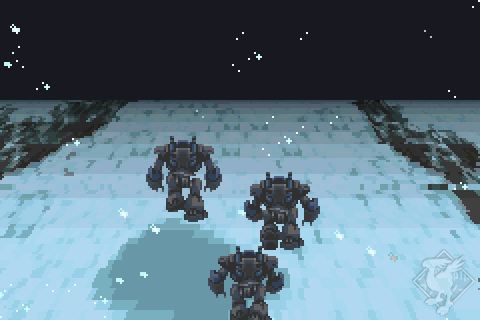
The intro plays, and within 5 minutes you’re equipped with all of the tools and information you need to start your journey: a war took place that resulted in the loss of lives, technology, and magic. As humanity regrew, so too did a corrupt empire that desperately wants their hands on something called an “Esper”. You take control of a couple grunts and an unnamed woman piloting beastly machines called Magitek Armor, marching toward the town of Narshe in presumed hopes of reaching this Esper before the Empire. You blast your way through Narshe, destroying all opposition without effort or thought. Once through the town and at the end of the cave system housing the Esper, you fight a simple boss that acts as a last-ditch effort to keep you away, but after some clever tutorialization that teaches you to be patient and read your foes, you arrive at your destination and are left only with Terra, the previously unnamed woman. She snaps out of the Empire’s mind-control, unable to recall anything but her name, and to her the natural ability to call upon the lost power of magic. This entire intro you were working for the Empire without your knowledge.
It’s through Terra that we’ll meet the bulk of our playable cast which is not only vast, but diverse and deep. I love Terra’s struggle for self-discovery; Locke’s many masks hiding his underlying pain over Rachel; Celes’s yearning for companionship and love. Everyone has real motivation and their own stakes in the story, and what makes them so special is that anybody can be your protagonist. You have near-complete control of your party at all times, meaning you could run through the game with a 4-man wrecking crew of Celes, Setzer, Sabin, and Umaro.. or you could go crazy and do a solo run with just Gau.
Who are the cast of heroes without some villains to oppose them?
First, we have Ultros: his comedy always lands, his motives are nonsensical, and he has just enough screen-time that he never gets old. This game gets dark– REALLY dark, and its through brief moments of comic relief that the player and the characters get any kind of breathing room.
Gestahl, on the other hand, is probably the most evil of the villains. His evil is personal and intentional. He broke down the barrier between the human world and the Esper world, raided a nearby village while kidnapping and killing the Espers that live there. He found a human infant crying, clutched in her weakened mother’s arms, and he ripped the baby away. When the mother desperately attempted with the little strength she had left to retrieve her baby from Gestahl, he gutted her in cold blood, laughing as he carried the baby girl back to his world where she lived her life enslaved.
Kefka is one of the greatest Final Fantasy villains of all time. I cannot point to any one moment that truly defines him as such, because he steals the show every time he’s on screen. His laugh alone will send chills down your spine later in the game. Kefka is maniacal, twisted, selfish, and… bored. He feels only temporary enjoyment in every depraved act he commits, which includes killing General Leo, killing the Emperor, torturing Espers then throwing them into the literal trash to rot away, and poisoning an entire Castle. All of this before what makes Kefka an extremely unique villain even if you ignore his personality and aforementioned acts: he wins. Kefka is the villain who achieved his goal in gaining ultimate power and destroying the world. He has achieved his goal so surely that even after you defeat him, the question still stands about whether or not the world can truly recover.
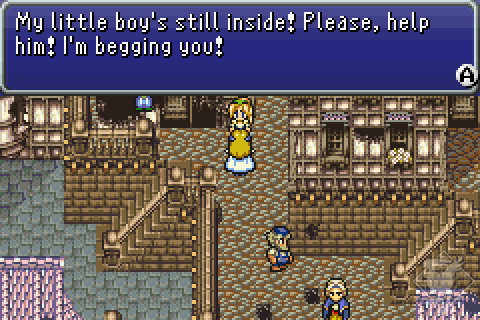
When Kefka disrupts the balance of the Warring Triad, he unleashes a devastating power that literally breaks the world. Continents split and shift; plants, animals, and people die; oceans turn murky and sour as they fill with rotting life and debris; towns are destroyed, ablaze, and abandoned as the remaining populace cower in fear of Kefka’s wrath from his looming tower. This is a powerful, grim section of the game that I absolutely love. The harsh transition and stark contrast between the World of Balance and the World of Ruin is filled with so much gloom and hopelessness that I’ve known people who can’t even stomach playing it.
The opening moments of the World of Ruin begin on a small island. On this island (and potentially elsewhere) the monsters you’ll encounter will attempt to cast magic, but fail because they lack MP. You can easily wipe these creatures out because they’re more than defenseless– you don’t even have to deal damage, as they will slowly die on their own in the middle of the fight because they are simply too weak to continue living. This is some insane story and gameplay integration that showcases the dying world you inhabit.
We now reach the moment in the game that solidified Celes as my favorite character in Final Fantasy VI. She wakes up a year after the world ended, accompanied only by Cid who info-dumps a few depressing details:
- Everyone else that was on the island died off naturally or killed themselves.
- We’re probably all that’s left in the entire world.
- He has been taking care of you the best he can, but is dying.
Cid then collapses from exhaustion, driving Celes to try and save him. She steps out into this new world that seems to be wheezing and taking its final breaths, and rushes to the nearby shore to catch some fish to feed Cid. Despite the fish clearly being sickly, she’s short on alternatives and catches all the fish she can, returns to the house, and feeds them to him. He does his best to scarf down whatever he can stomach, and Celes leaves the house to get some more. She returns and Cid tries his best to eat, still struggling, and clearly requires more sustenance. Celes leaves for the shore to fetch even more. As she returns to the house, Cid doesn’t respond. He lays there, lifelessly staring at the ceiling, no longer struggling. No longer breathing. Despite her best efforts to nurture him back to health, Cid dies. She is now completely alone in a dead, broken world. Unable to cope with the loss of her only remaining hint of family, Celes bursts out of the house in tears, finding her way to a cliff side where she finds a bird rotting away. Death is all that’s left, and there’s nothing more she can do. With reluctance, tears still streaming down her face, Celes throws herself off the cliff and commits suicide. This has to be one of the darkest and most beautiful moments in all of gaming for me, and it breaks my heart in all the right ways.
Celes’s suicide attempt fortunately failed, waking to an injured bird at the shore. The bird is bandaged with the scarf belonging to a man she’s grown to love. With her newfound spark of hope that her friends may be alive, she returns to the house and finds a letter from Cid that she, in her grief, hadn’t noticed on the floor beside his bed. In the letter, Cid explains that he had been building a raft so Celes could leave the island and fight for survival elsewhere, and find her friends. It’s at this point in the game that the quest/plot structure becomes free and open. Where the World of Balance lightly guided you on a directed tour from plot point to plot point, the World of Ruin gives you a brief introduction to your new environment, and then completely opens up. Once you get the new Airship, you could skip the rest of the game’s content (which includes the remaining 11 playable characters) and beat the game if you really wanted to. This level of player agency puts so much on your shoulders and requires a lot of detective work that really fleshes out both the World of Balance and the World of Ruin in unexpected ways: from dream sequences with Cyan and Shadow, to Terra giving up the fight to instead protect a town of children, to Gau training as hard as he can so he can face Kefka one-on-one. All of these details you discover by traveling to different towns and talking with the townsfolk. They’ll either express their despair over the state of the world or off-handedly mention the presence and rumblings of one of your party doing something somewhere nearby. It’s up to you, then, to pursue those leads and reassemble your party, find new gear, and otherwise prepare yourself for Kefka’s Tower.
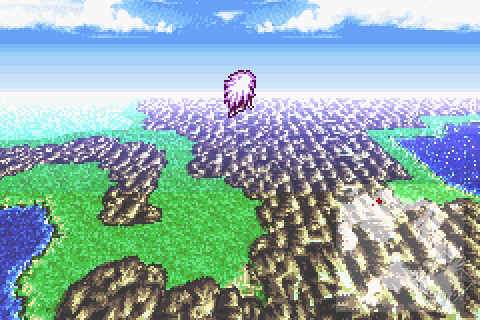
One of my absolute favorite aspects of the World of Ruin is the way it handles the overworld music. It’s so subtle you may have not even noticed, but man is it powerful stuff. By the time you reach the World of Ruin, you’ve grown accustomed to Terra’s Theme playing as you traverse the World of Balance on land and by Airship. It’s uplifting and adventurous! Then.. the world ends. When you step out into the World of Ruin, Terra’s Theme has been replaced by a droning organ, playing sickly notes that just makes the world feel.. dead. However; in one of the few mandatory story moments in the World of Ruin, you’ll get your hands on a new Airship. The triumphant song that plays as you pilot it out of the ocean and into the sky becomes the new overworld theme. It’s hopeful and full of life, the mirror opposite of the World of Ruin’s overworld theme up to this point. In a simple, brilliant move, Squaresoft has instilled a small sense of hope in the player to correlate how the characters feel in that moment. It’s the spark that will drive you forward to either gather the rest of your party or go face down Kefka once and for all. It’s honestly quite genius, and wonderfully subtle.
Without question, this is a game worth playing. It’s one of those experiences that will stick with you forever, and you’ll be thinking about it long after you’ve completed it.
I can safely recommend Final Fantasy VI to everyone with a heartbeat.



RESOURCES
To help keep track of my moment-to-moment tasks, I jotted down key events and ideas so that I had an idea of where to pick back up when I next booted up the game, or if I planned on deviating from the main story for a while to take care of side-content:
I made a map and noted key details for the World of Ruin so I could keep track of locations and events for the current playthrough and possible future ones:
