
Death Stranding

- Intro
- Story
- Gameplay
- Presentation
- Spoilers
- Conclusion
Death Stranding is a beautiful expression of Hideo Kojima's freedom to flex his creative muscles. As a famously hard-working auteur that prides himself on quality and attention to detail, witnessing first-hand the way his creative process molded and shaped his debut title as a standalone developer is nothing short of humbling and enlightening. There’s a lot riding on this game and the masses have eagerly awaited its arrival following the magnificently strange trailer that was showcased at E3 2016.
Narratively speaking, Death Stranding is about as strange as should be expected, while remaining surprisingly followable. Set in a post-apocalyptic America whose infrastructure of roads and cities have collapsed, the player controls Sam Bridges, a courier with the weight of the world on his shoulders tasked with reconnecting the remnants of America through a network similar to the internet in order to mend the now fractured country into a single whole and prevent society from withering to nothingness. Sam braves the hazardous American wasteland to fulfill this goal while also performing secondary missions as a general deliverer of supplies, technology, and even people across the nigh-untouched expanse of nature between small communities all of whom remain cloistered away in fear of the major threats borne from the Death Stranding.
This titular event has uprooted and shifted the very fabric of the world’s ecosystem in ways that are too complex and spoilery to delve into, and a lot of the intrigue of the story lies within these details. Primarily, there are three major ways that it has impacted both the lives of the setting’s inhabitants and the gameplay. Timefall rains from special clouds, rapidly aging anything it comes into contact with. It also houses the spectral Beached Things, lying in wait to snatch and consume those foolish enough to cross into their territories. Death is no longer the end as corpses become BTs themselves, ready to feast on the living and spark a voidout-- a matter-antimatter reaction with a destructive power equivalent to that of a nuclear bomb. There is a lot of nuance to this cycle and I found myself hooked in discovering all that I could.
The impressively long cutscenes that Kojima is famous for stitch together each extensive stretch of gameplay, constantly pushing the envelope both in terms of technical capacity and narrative complexity. Plot details are conveyed through symbolic visuals and philosophical dialogue that keep both Sam and the player guessing, sometimes so aggressively that it's all you can do to keep your head above water. Early hours of the game don’t even try to clue you into its various plot points, instead thrusting you knee-deep into events and scenarios that only make sense in hindsight after some progress has been made. The game’s blending of the supernatural with technology results in a fascinating science fiction full of amazingly detailed and captivating lore presented in an incredibly engaging slow burn.
Kojima’s unique style and love of pop culture shine a quirky and sometimes humorous light through the thick fog of this depressing apocalypse. Dialogue is comprised of memorable one-liners or treads into profound, near-pretentious territory a-la The Matrix, and characters often break the fourth wall by winking directly at the camera or referring to story events as part of a game with boss fights and game-overs. It’s great stuff that further lends a distinct identity for the title.
The game sees you controlling a physics-influenced character that’s poked and prodded by the world they traverse, somewhat reminiscent of Ico or Shadow of the Colossus. Death Stranding takes this concept to an extreme by turning the most fundamental feature of any adventure game, walking, into the sole, naked gameplay focus that’s manipulated and supported by hundreds of systems. It skillfully frames the conceptually mundane as a legitimate struggle and hardship with each successful venture instilling a feeling of being the most badass mail delivery man in America.
Sam's balance drives the moment-to-moment gameplay, influenced by the weight and distribution of his cargo that determines how susceptible he is to fall while journeying between locations. This is made interactive by putting the player in control of where each individual tool and container of cargo is stored on Sam's body, and by pulling on the triggers of the controller Sam will tug on the straps that bind the cargo to his back thereby adjusting its weight distribution. So if he is about to fall to his right you can pull on the left trigger to shift the cargo's weight in that direction and correct his balance, and holding both triggers offers the most stability but also slows down Sam's movement. In a game where at least 50 hours of time will be spent walking, sometimes on a timer or under the pressure of hostile forces or environments, movement speed means more than one might expect and frankly the act of perpetually holding the triggers can be strangely strenuous.
America's terrain is a deceptively treacherous obstacle where even small rocks or slight slopes can make Sam trip and fall, damaging his cargo and lowering his score upon delivery. Because of this, planning the way forward is paramount to a safe trip and requires spending at least some attention to the ground on which he walks. Tapping R1 scans the environment and displays an overlay atop the terrain that conveys the fall-risk of each small measure of land, even indicating whether rivers are of a dangerous depth. Highlighting the world in this way illustrates just how brilliant the level design is because it strips away the aesthetics to show the underlying features and affordances that the world is constructed with. It trains your eye to look beyond what would be simple terrain in other games and see that each rock, field, cliff, river, and patch of mud has their own traits and effects on Sam’s movement.
Encounters with the BTs are some of the most captivating and nail-biting events in the game. Stumbling into a herd of these ghostly creatures feels like being tripped mid-sprint as the usual gameplay violently halts to become a stealth-based horror game. Sam must avoid contact with the BTs to prevent being consumed and triggering a voidout. BTs are blind but can hear Sam’s footsteps and even his breathing, so he must move quietly by walking slowly or crouching and hold his breath if he gets too close. Using the Bridge Baby strapped to Sam’s chest allows the player to visualize the BTs in their immediate area and will otherwise passively aim Sam’s Odradek scanner in the direction of the nearest BT. These moments are tense and mesmerizing, even if they drastically increase the time it takes to reach a destination.
Progressing through the story and completing side missions unlocks numerous features that add conveniences or depth to the game’s base systems. For example, you eventually unlock a bike that can be used to travel faster with less risk of damaging your goods. You can even load excess cargo onto the bike itself and take on more orders at once with the extra room. This convenience is balanced, however, by making the bike extremely sensitive to rocks and other rough terrain as well as a limited battery that must be recharged either over time or through power-generating structures.
Where the traversal mechanics are the body of Death Stranding, its heart is Kojima’s self-proclaimed new “strand” genre and its community interaction. Most multiplayer games see players directly playing with and against one another, like in a Call of Duty deathmatch or World of Warcraft raid; other games offer asynchronous multiplayer where one might see the effects of other players without directly interacting with them, made most famous by the Soulslike genre. However, where those titles provide the tools to trick other players or invade their worlds to attack them, Death Stranding’s asynchronous multiplayer is centered around reinforcing positivity and emotionally bonding with others. This is a refreshing take on the concept and I’m amazed by how connected I feel to a community that I’ve never seen or talked to. Knowing that my actions can impact someone else’s experience in a positive way without any means to act maliciously had me constantly considering how placing structures and equipment will affect not only myself but those they will be shared with. It’s easy to overlook how potent the power of this system can be until you’re on the receiving end, especially in a time of dire need. Finding yourself stuck in a downpour of Timefall, all equipment expended on the journey to this point, surrounded by hungry BTs with no means to defend yourself and running ever-lower on the stamina required to run, climb, and hold your breath is an unflinchingly intense experience. Then, turning a corner to find a ladder placed by another player leading to the other side of a river that puts distance between you and the BTs can feel akin to being rescued from a burning building. This isn’t a one-off scenario where all of the stars just happened to align, these moments are frequent and last the entire game. It’s a beautiful marriage of systems that craft unforgettable experiences and otherwise made me feel more whole than any other game has managed.
There's an addictive quality to the mission structure. Taking orders, adjusting your cargo, fabricating recommended and anticipated equipment, charting your potential course, making the trek, adapting to the challenges along the way, reaching your destination and delivering your goods to be graded and rewarded-- it's a bullet-proof gameplay loop that was difficult to put down. Even new orders between familiar routes become fresh with new items, equipment, and threats.
If there’s one recommendation I can give to newcomers, it would be to not underestimate Timefall as I did early on. Its effect on your cargo and equipment is surprisingly damaging, so avoid it whenever possible or at least bring repair spray to undo the damage.
Kojima games are all about the little details often in service of immersing the players in his wacky worlds, and Death Stranding is an ocean of them. For example, the player must contend with footwear durability on their travels, so finding ways to delay the inevitable demise of Sam’s boots might lead to the player going out of their way to walk on paved roads or to discover that they can use empty floating carriers as skateboards to hover just above sharp rocks. Some of these small details will surprise the player by making themselves known during typical gameplay experiences, such as Timefall turning dirt into mud which slows down movement and can even make Sam slip if tread-upon carelessly. If your cargo is stacked high-enough and collides with a ceiling or other obstruction, the impacted cargo will fall to the ground.
Even the DualShock 4 is home to a host of these details, such as BB's audio coming from the controller speaker. The genius of this is that when BB is attached to Sam's chest, it is in a location similar to where the player's controller naturally rests during play. Soothing BB requires Sam to detach it from his chest and hold it, placing BB in Sam's hands just as the controller is in the player's hands as they gently rock BB up and down in front of them. This particular detail is driven home even further with the controller that came with special editions of the game, designed after BB’s semi-transparent orange pod.
Rumble and haptic feedback aren’t new to gaming, but most applications of the technology range from uncreative to non-existent. Death Stranding takes advantage of this additional sensory feedback by making you feel what Sam feels. Walking on rough terrain will send gentle rumbles to your fingertips with each step. Interacting with items, objects, and the world lightly pulses the controller to simulate the act of touching.
No game is perfect, however, and I have a number of gripes. Chief of these are the recurring cinematics and animations. Most are harmless and all serve to pull the player deeper into the world, but there’s no reason we shouldn’t have the option to disable some of the ones that repeat ad nauseam. I’m especially annoyed by the animation that plays when BTs are detected which subjects the player to a 5-10 second animation of Sam’s Odradek scanner ejecting from his shoulder and whirring to life. While it does a good job emphasizing the danger of the situation, the player no longer requires that emphasis after one or two encounters. Any number beyond a small handful of recurrences can not only break the pace, but also the player's concentration and, ironically, immersion.
With how often Sam’s cargo must be accessed, a shortcut to the cargo menu would have been greatly appreciated. I’d have mapped it to holding the triangle button, gladly forfeiting its current function of offloading all cargo which is something I literally never did a single time in my 70+ hours.
A minor nitpick to be sure, but I wish it was possible to thumbs-up zip-lines while riding them, or at least when stopped at one because the inability to do so results in a lot of mid-network zip-lines getting no love.
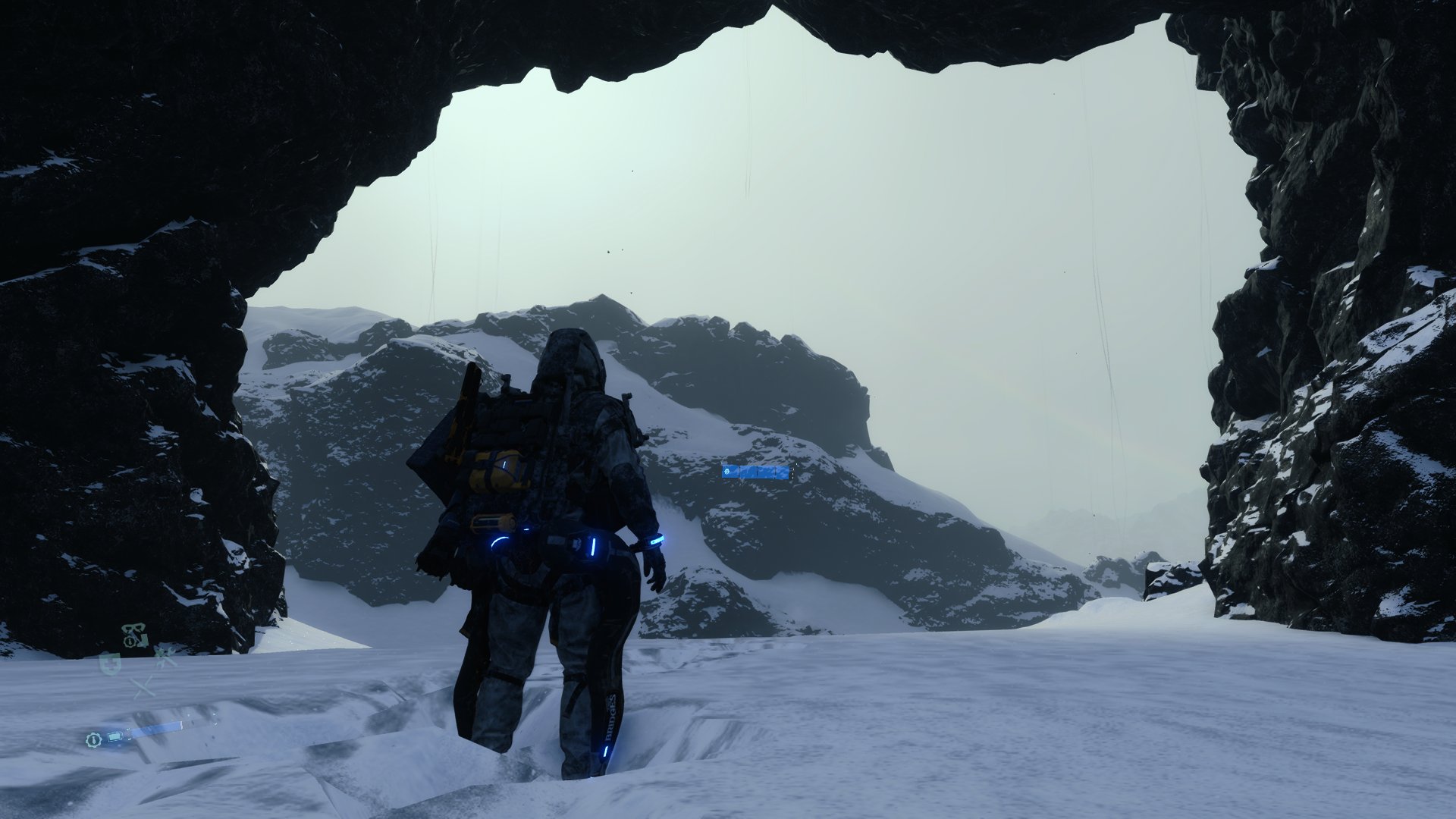
Even on a standard PlayStation 4, the game is visually arresting. Nature has never looked so picturesque, truly looking as though the country is an ancient and untrodden land. It’s a unique visual style that emanates trepid peace and cold isolation unlike other stunningly vibrant works like Red Dead Redemption 2 or God of War. Where Death Stranding’s visuals really shine, though, are the supernatural locales that bleed death, destruction, and eldritch horrors. These moments of fantasy are so vivid and cool that my only complaint is that they are few and far between, mostly backloaded for the mind-numbingly epic finale.
The game utilizes photogrammetry technology to scan objects and actors into the engine which results in an uncanny level of photorealism. For the most part it all works very well, with only a few key moments where character faces looked strange or off-putting. Overall, however, I think this might be the most impressive result of the technology to date.
Cinematics are directed with striking flair and artistic vision, demonstrating Kojima's love of film. The camera is framed with skill, colors are used to highlight and lure attention, and most elements are tethered together with natural and fluid animations. Some of Sam’s navigation animations are more jittery and frantic than I think they should be, climbing and jumping looking particularly strange and you never know what to expect from either, but these only stick out so much because of their stark contrast against the otherwise beautiful work on display.
The audio is basically perfect, complete with insane sound design, a fierce score, impeccable voicework, and an emotional and atmospheric soundtrack.
Death Stranding’s music is comprised of incredible synth pieces that are as energetic as they are ominous. The feeling of isolation is exacerbated by the sparseness of its presence, only coming out to play during important events and to highlight actions or the atmosphere of any particular moment. Kojima's musical taste bleeds into the game by injecting commercial works into the more cinematic moments, like those used in the many trailers leading up to the game’s release. I love when these kicked in because of the unique mood they set and how they emphasized the importance of the steps I was taking at that time. I'll Keep Coming by Low Roar is a deep, dark tune that perfectly complements the game’s setting, and I love Ludvig Forssell’s Once, There Was an Explosion.
Every performance is outstanding. Standouts for me are Clifford Unger (Mads Mikkelsen) and Higgs (Troy Baker) who give alluring and whole-hearted performances. It would be a crime to not mention Sam Bridges (Norman Reedus) who might not have much to say, but that makes what he does muster even more impactful. His body language tells a story of its own if you have a keen eye, a subtlety likely unnoticed until called attention to later on.
The game hums and whistles to life with howling winds and synthetic chimes ringing softly, echoing in the canyons and valleys of a hollow and rocky America. Each footstep squeaks and rubs against rocks and gravel with gritty tension. Timefall pours like a waterfall, each droplet breaking apart in shards against structures and terrain. Sound design is an oft-overlooked and under-appreciated aspect of a game’s audio, but it’s something I’ve grown acutely aware of over the years. Lacking in this department results in empty and lifeless games, and Death Stranding serves as a prime example of how superb sound design can be a game’s very pulse, breathing life to a world constructed with math and imagination.
Reading and understanding the user interface was a struggle for a good chunk of the experience. Tons of icons and details litter each menu and while they aren’t messy, I think too much of the content is unclear. Some of it pieced together for me many hours in, and I absolutely see the value in what is shown, but the presentation needs cleaning up and tweaking.
The HUD fairs far better, offering just enough information without going overboard. Certain on-screen elements don't appear at all until they become relevant, such as the battery meter or Sam’s consciousness bar, further clearing up screen real-estate to keep the player focused on the action.
Tutorials are organically woven into the game as the player stumbles across their relevant systems or mechanics. Drip-feeding content this way prevents the moment-to-moment gameplay from feeling oversaturated in the sheer quantity of percentages, bars, and other intricacies that would otherwise smother the experience. All discovered tutorials can be accessed at any time through the main menu which is much appreciated when so many systems interact with one another in ways that are sometimes easy to forget.
I expected a twist of some sort, considering Kojima's history, but I was genuinely shaken and frightened by Death Stranding’s sudden mutation from optimistic odyssey to something darker with Sam's nightmare bleeding into real life as he awakens to harsh red lights, sirens, Amelie's distorted voice, and the colossal BT mimicking her movements. It’s an unnerving tonal shift that signals the final hours of the game in an unforgettable way.
Journeying back East after reaching Amelie feels like a rollercoaster. It begins almost triumphantly before swiftly spiraling into chaos as you discover the impact of the Chiral network you've spent the whole game establishing thus far. Being forced to trudge through endless Timefall Storms, lethal MULEs, and highly sensitive BTs turns what you thought was a benefit to the country into a cancer that has been festering and eating away at it in your wake as you pressed on Westward. This development is also a smart way of 'leveling-up' early game areas so that they remain a challenge this late in the campaign.
The final scenes confidently deliver on the vague promises of those initial trailers we saw years ago. Fantastical landscapes, profound monologues, gut-punching decisions, creative gameplay, and narrative pieces that discuss issues everyone can relate to and understand in a context that's both horrifying and intriguing. Sam being the BB that Cliff had been searching for is actually a revelation I had guessed at hours before its unveiling, but I love the plot point all the same. This did confuse me for some time as I struggled to make sense of the difference between Cliff’s BB and Sam’s BB until I realized that she's a red herring, unrelated to the memories Sam would experience of Cliff.
Fans of methodical adventure titles will love this game and its almost insane systematic depth, but it likely won’t please fans of face-paced action. Those that haven’t partaken in Kojima’s past works might be unprepared for the story and its presentation, particularly with the length of its cinematics. But if you find yourself disliking them or even being indifferent to them, most if not all cutscenes can be skipped. Experiencing a game as isolated and unique as Death Stranding is something I can recommend to anyone because not doing so feels like a disservice to art, only perhaps wait for a sale if you aren’t fully on board with its concept and ideas.
There was no doubt in my mind that I would love this game. I’m a huge fan of Hideo Kojima and his work, and the title on offer fits right into my arthouse sensibilities. Death Stranding seems like it was made for me with its overwhelming positivity, intensely focused vision, and a uniquely creative story performed by actors that I love and influenced by directors I adore. It stands in direct opposition to modern trends of today and challenges not only what we perceive as games but how we perceive each other. Death Stranding doesn’t need to be a perfect game because what it says and how it says it is more important, and that’s the hallmark of a true masterpiece.
Pros
- Reflective and thought-provoking themes and subject matter
- Creative and innovative gameplay
- An aggressive push toward social positivity
- Beautiful and inventive visual identity
- Untouchably soulful audio design
Cons
- Too few moments of fantasy
- No way to disable repeat animations




LOVE
Similar Games
- Shadow of the Colossus
- Metal Gear Solid V: The Phantom Pain
- Journey